
8 Best Low Profile Conventional Window Air Conditioners of 2026
Selecting a low profile conventional window air conditioner requires balancing cooling power, installation fit, and quiet operation. Our evaluation focuses on units that deliver efficient cooling for small to medium rooms without dominating your window space.
 By Daniel Brooks
Updated October 7, 2026
By Daniel Brooks
Updated October 7, 2026
Choosing the right low profile conventional window air conditioner is essential for cooling small bedrooms, home offices, or apartments without sacrificing your view or dealing with excessive noise. These units are designed to fit standard double-hung windows and provide a focused cooling solution where central air isn’t available or practical. Key considerations include the cooling capacity for your room size, the physical dimensions of the unit to ensure a proper fit, and the noise level for undisturbed comfort. For a broader look at options, explore our guide to window air conditioners.
This guide is built for anyone needing an effective, space-conscious cooling solution. We compared eight models based on manufacturer specifications, focusing on their suitability as low profile conventional window air conditioners. The evaluation prioritized verified cooling capacity, window fit requirements, noise output, and energy efficiency to help you find the best unit for your needs.
All Products Compared
| Product | Best For | Cooling Capacity | Room Size | Noise | Notable Feature |
|---|---|---|---|---|---|
| Midea 5,000 BTU EasyCool Window Air Conditioner | Small rooms on a budget | 5,000 BTU | 150 sq. ft. | Quieter than a refrigerator | Mechanical controls, 11.0 CEER |
| Frigidaire 5,000 BTU Window Air Conditioner | Quiet operation in bedrooms | 5,000 BTU | 150 sq. ft. | 52 dBA | Auto Restart, washable filter |
| LG LW8024RD 8,000 BTU Window AC | Medium-sized rooms | 8,000 BTU | 350 sq. ft. | 53 dB (low mode) | Electronic control with remote |
| Midea 5,000 BTU Window Air Conditioner | Remote-controlled small room cooling | 5,000 BTU | 150 sq. ft. | 52 dB (low mode) | Remote control, dehumidifier mode |
| GE 5,000 BTU Window Air Conditioner | Most affordable option | 5,000 BTU | 150 sq. ft. | 52 dBA (low) | Simple mechanical controls |
| GE Profile ClearView 10,300 BTU Window Air Conditioner | Larger rooms with a view | 10,300 BTU | 450 sq. ft. | 40 dB | Full window view, inverter tech |
| GE Profile ClearView 8,300 BTU Window Air Conditioner | Ultra-quiet cooling with smart features | 8,300 BTU | 350 sq. ft. | 40 dB | Built-in condensate pump, WiFi |
| Midea 8,000 BTU Smart Inverter Window Air Conditioner with Heat | Multi-season comfort with high efficiency | 8,000 BTU | 350 sq. ft. | 45 dBA | Inverter with heat pump, smart app |
| Award | Product | WikiCooling Score About WikiCooling ScoreThe WikiCooling Score is our own rating from 0 to 10, based on the criteria described on our How We Review page. It reflects research, not laboratory measurement, and is never influenced by manufacturers, retailers, or affiliate commissions. Learn more › | |
|---|---|---|---|
| Best Overall |
 Midea 5,000 BTU EasyCool Window Air Conditioner
|
8.4/10 | Buy |
| Best Budget |
 Frigidaire 5,000 BTU Window Air Conditioner
|
8.3/10 | Buy |
| Best Premium |
 LG LW8024RD 8,000 BTU Window AC
|
8.3/10 | Buy |
 Midea 5,000 BTU Window Air Conditioner
|
8.1/10 | Buy | |
 GE 5,000 BTU Window Air Conditioner
|
7.6/10 | Buy | |
 GE Profile ClearView 10,300 BTU Window Air
|
7.0/10 | Buy | |
 GE Profile ClearView 8,300 BTU Window Air
|
7.0/10 | Buy | |
| Best Value |
 Midea 8,000 BTU Smart Inverter Window Air
|
8.0/10 | Buy |
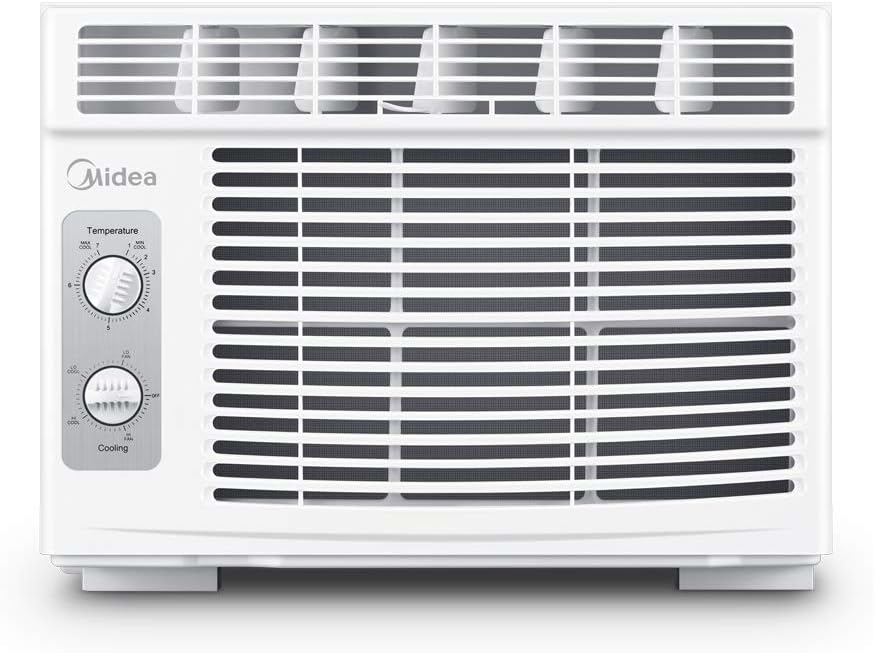
Midea 5,000 BTU EasyCool Window Air Conditioner
This small window air conditioner is a mechanically controlled unit designed for cooling spaces up to 150 square feet. It offers a straightforward installation process and a washable filter for simple maintenance, making it a practical, budget-friendly option for rooms like bedrooms and home offices.
Pros
- Effective cooling capacity for its recommended room size.
- Mechanical controls are simple and intuitive to operate.
- Energy efficiency rating of CEER 11.0.
- Includes a washable and reusable filter.
- Comes with a 1 Year Parts & Labor Warranty.
Cons
- No remote control or smart features.
- Fixed installation requirements suit specific window sizes only.
- Operates at 57 db, which some buyers mention is noticeable.
Frigidaire 5,000 BTU Window Air Conditioner
This Frigidaire window air conditioner cools rooms up to 150 sq. ft. with 5,000 BTU. It operates quietly at 52 dBA and features two fan speeds and effortless temperature control. Ideal for small bedrooms or living spaces.
Pros
- Quiet operation at 52 dBA
- Easy-to-clean washable filter
- Auto restart feature
- Adjustable side panels for fit
- Two fan speeds for customization
Cons
- No inverter compressor
- Manual button controls only
- Heavy at 35.3 pounds
LG LW8024RD 8,000 BTU Window AC
For medium-sized rooms up to 350 square feet, this LG window air conditioner combines quiet operation with practical features. Its 4-way air deflection and three cooling speeds allow customized airflow, while the auto restart function ensures comfort after power outages. The included remote and washable filter add convenience, making it a solid choice for bedrooms or living areas.
Pros
- Quiet operation as low as 53 dB
- Auto restart after power outage
- Washable filter for easy maintenance
- Remote control included
- 4-way air deflection for targeted cooling
Cons
- No inverter technology (on/off compressor)
- Moderate energy efficiency (SEER 11.4)
- Heavy unit at 57 pounds
Midea 5,000 BTU Window Air Conditioner
Designed for small spaces up to 150 square feet, this Midea window air conditioner offers reliable cooling with a 5,000 BTU capacity. Its quiet operation at 52 dB and included remote control make it a convenient choice for bedrooms or home offices. The washable filter and EcoSave mode add to its appeal for budget-conscious users.
Pros
- Quiet operation at 52 dB
- Washable reusable filter
- Remote control with multiple modes
- Easy installation with included bracket
- Auto restart after power loss
Cons
- No inverter compressor
- Fits only standard double-hung windows
- Heavy at 35.5 pounds
GE 5,000 BTU Window Air Conditioner
A budget-friendly window AC for small spaces up to 150 square feet, this GE unit uses simple mechanical controls and two cooling modes. It operates quietly at 52-56 dBA, making it suitable for bedrooms and dorm rooms. Easy DIY installation fits double-hung windows 27 to 36 inches wide.
Pros
- Quiet operation at 52-56 dBA
- Easy mechanical controls, no setup
- Washable filter, low maintenance
- Low power draw at 440 watts
- Fits narrow windows down to 27 inches
Cons
- Fits only double-hung windows
- No smart or remote control features
- May need wider side panels for extra-wide windows
GE Profile ClearView 10,300 BTU Window Air
Designed to sit below the window sill, this 10,300 BTU inverter window AC preserves the full view and allows natural light. It cools rooms up to 450 square feet with ultra quiet operation as low as 40 dB, and includes WiFi connectivity for remote control via the SmartHQ app. Best for users who prioritize low noise and smart features without sacrificing window visibility.
Pros
- Ultra quiet operation (40 dB)
- Full window view design
- Inverter technology for efficient cooling
- WiFi smart control with app
- Flex-depth fits various wall thicknesses
Cons
- Heavy at 75.7 pounds, may require two people for installation
- Can cause wall vibration when compressor runs
- Only compatible with double-hung windows
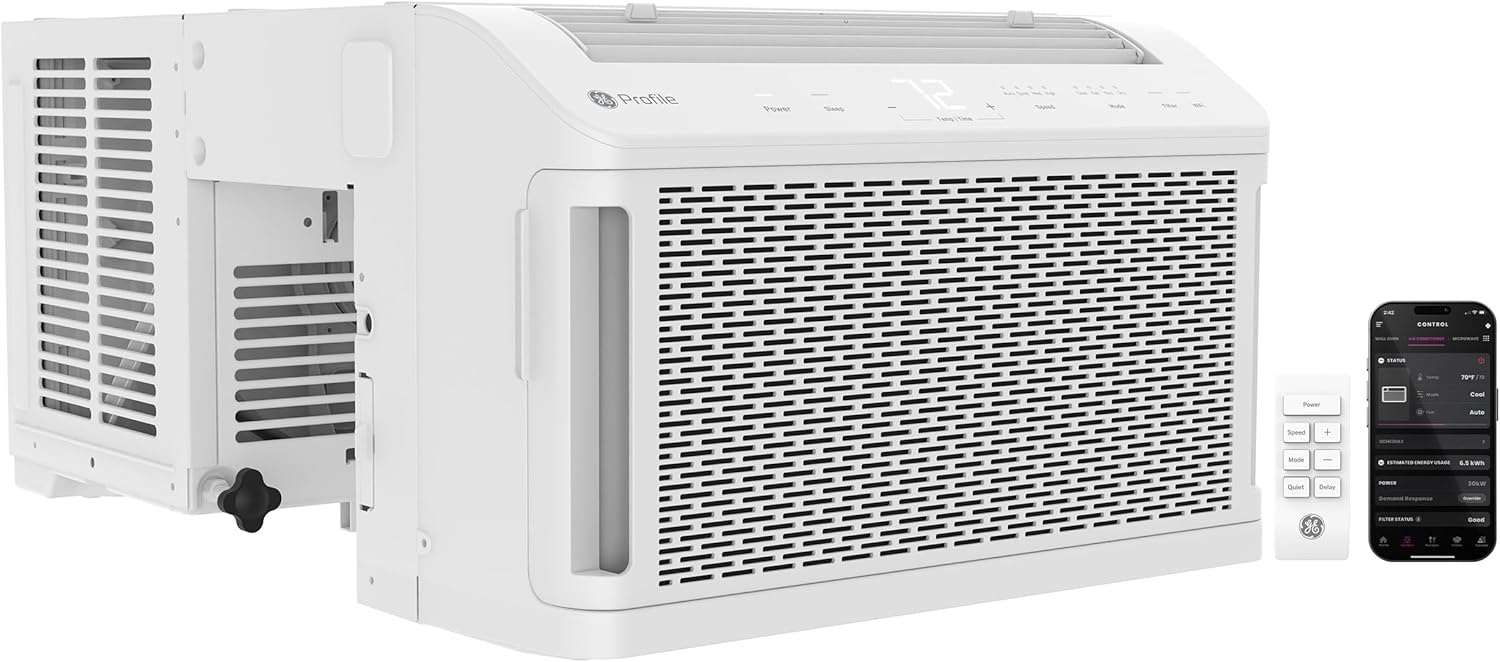
GE Profile ClearView 8,300 BTU Window Air
Designed to maintain a full window view, this 8,300 BTU unit cools medium rooms up to 350 sq ft while operating as low as 41 dB. Its built-in WiFi enables remote control via the SmartHQ app, and the flex-depth design fits walls 4.5 to 13.75 inches thick. Ideal for bedrooms and living rooms where quiet operation and natural light are priorities.
Pros
- Ultra quiet 41 dB operation
- Full window view preserves natural light
- Flex-depth fits various wall thicknesses
- WiFi and voice control compatible
- Auto pump eliminates condensate draining
Cons
- Heavy at 65 pounds for installation
- No inverter for variable speed cooling
- Fits only double-hung windows
Midea 8,000 BTU Smart Inverter Window Air
This Midea window unit combines cooling, heating, and dehumidification for year-round comfort in rooms up to 350 square feet. Its inverter compressor and smart controls deliver quiet, energy-efficient operation, while the heat pump provides supplemental warmth when outdoor temperatures stay above 41°F.
Pros
- Quiet operation at 45 dB
- Energy Star certified with inverter technology
- Smart app and voice control
- Heating and dehumidifier functions
- Washable filter for easy cleaning
Cons
- Heat pump only works above 41°F
- Heavy at 56 pounds, may need help installing
- Fits only double-hung windows
Top 3 Low Profile Conventional Window Air Conditioners Reviewed
#1 Midea 5,000 BTU EasyCool Window Air Conditioner: Best Overall
Why We Picked It
The Midea 5,000 BTU EasyCool Window Air Conditioner earns the top spot for its proven combination of effective cooling, straightforward operation, and energy efficiency, making it an ideal low profile conventional window air conditioner. Its 5,000 BTU capacity is precisely matched for rooms up to 150 square feet, such as small bedrooms or home offices, ensuring it provides adequate cooling without being oversized. The mechanical controls offer simple, reliable operation without the complexity of digital interfaces, which is perfect for users seeking an uncomplicated appliance.
Compared to other picks, this Midea model stands out for its high Combined Energy Efficiency Rate (CEER) of 11.0, which can help reduce annual energy costs. Its noise level, described as quieter than a household refrigerator, also makes it suitable for sleeping areas. While it lacks a remote control, its physical dials provide immediate tactile feedback and eliminate the need for batteries or signal issues, offering a dependable user experience for a low profile installation.
Key Specifications
- Cooling Capacity: 5,000 BTU
- Room Size: 150 sq. ft.
- Noise Level: Quieter than a refrigerator
- Efficiency: 11.0 CEER
- Window Fit: 23”-36” wide, 13” min. height
| Pros | Cons |
|---|---|
|
|
Things to Consider
Before purchasing, verify your window dimensions fall within the required 23 to 36 inches wide and have a minimum height of 13 inches. The unit uses mechanical controls, which means all adjustments must be made directly at the unit; there is no remote for convenience from across the room. Installation requires a screwdriver, and for some window frames, pre-drilling pilot holes is recommended for a secure fit, as noted in the manual.
Best For
This unit is best for budget-conscious users who need reliable, efficient cooling for a small room like a bedroom or office and prefer simple, manual controls over smart features. It is a solid, no-frills workhorse that gets the job done quietly and effectively.
You can find the Midea 5,000 BTU EasyCool Window Air Conditioner for your cooling needs.
#2 Frigidaire 5,000 BTU Window Air Conditioner: Best for Quiet Operation
Why We Picked It
The Frigidaire 5,000 BTU Window Air Conditioner is selected for its focus on quiet performance and user-friendly features, making it a strong contender among low profile conventional window air conditioners. With a specified noise level of 52 dBA, it operates at a volume conducive to sleep and concentration, ideal for bedrooms or small living spaces. Its Effortless Temperature Control feature helps maintain a consistent preset temperature, reducing frequent adjustments and potential noise fluctuations from the compressor cycling on and off.
This model compares favorably to our top pick by including an Auto Restart function, which automatically restores your settings after a power outage, a useful feature in areas prone to brief electrical interruptions. The washable filter is designed for easy maintenance, promoting better air quality and unit longevity. While its efficiency rating isn’t listed like the Midea’s, its performance and focus on low-noise operation give it a distinct advantage for noise-sensitive environments.
Key Specifications
- Cooling Capacity: 5,000 BTU
- Room Size: 150 sq. ft.
- Noise Level: 52 dBA
- Feature: Auto Restart
- Filter: Washable
| Pros | Cons |
|---|---|
|
|
Things to Consider
Potential buyers should note that the energy efficiency rating (CEER or EER) is not provided in the listed specifications, which may be a factor if operating cost comparison is a priority. The unit includes adjustable side panels to fit your window securely, but always confirm your window’s dimensions are compatible. The extra-long power cord is a convenience, but ensure you have an appropriate outlet nearby that can handle the unit’s 115V, 450W electrical draw.
Best For
This Frigidaire is best for individuals who prioritize a quiet sleeping or working environment and value convenience features like auto-restart and easy filter maintenance in a compact, 150 sq. ft. cooling package.
Consider the Frigidaire 5,000 BTU Window Air Conditioner for a peaceful cooling solution.
#3 LG LW8024RD 8,000 BTU Window AC: Best for Medium Rooms
Why We Picked It
The LG LW8024RD 8,000 BTU Window AC is chosen for its ability to cool larger spaces while maintaining a relatively low profile and user-friendly operation. Its 8,000 BTU output is suitable for rooms up to 350 square feet, bridging the gap between small units and more powerful models. This capacity makes it versatile for medium-sized bedrooms, living rooms, or open-plan spaces where a 5,000 BTU unit might be insufficient.
This LG model differentiates itself from the smaller-capacity picks with electronic controls and an included remote, offering modern convenience for adjusting settings from across the room. The 4-way air deflection helps distribute cool air more evenly throughout the space. While its low-mode noise level of 53 dB is slightly higher than the Frigidaire’s, it remains reasonable for its higher cooling output, and features like a 24-hour timer and Auto Restart add to its functionality as a capable low profile conventional window air conditioner for larger areas.
Key Specifications
- Cooling Capacity: 8,000 BTU
- Room Size: 350 sq. ft.
- Noise Level: 53 dB (low mode)
- Controls: Electronic with remote
- Feature: Auto Restart, 24-hour timer
| Pros | Cons |
|---|---|
|
|
Things to Consider
This unit’s larger cooling capacity requires more power and may produce more noise, so it’s important to ensure your room truly needs 8,000 BTUs to avoid overcooling and inefficiency. Check that your window can accommodate the unit’s physical dimensions, which are not listed but are typically larger than 5,000 BTU models. Also, verify that your electrical circuit can support the unit’s 115V operation without overloading, especially if other appliances are on the same circuit.
Best For
The LG LW8024RD is best for cooling medium-sized rooms up to 350 sq. ft. where remote control operation and scheduling features are desired, and where a higher cooling output is necessary for comfort.
Explore the LG LW8024RD 8,000 BTU Window AC for larger space cooling.
How to Choose a Low Profile Conventional Window Air Conditioner
Match Cooling Capacity to Your Room
Selecting the correct BTU (British Thermal Unit) rating is the most critical step. An undersized unit will run constantly without cooling the room effectively, while an oversized unit will cool too quickly without properly dehumidifying, leading to a cold, clammy feel and inefficient short cycling. Always use the manufacturer’s stated room size recommendation as your primary guide, as it accounts for the unit’s specific performance.
ENERGY STAR publishes this general guide for sizing a room air conditioner by floor area:
| Room Size (sq ft) | Cooling Capacity (BTU/hr) |
|---|---|
| 100 to 150 | 5,000 |
| 150 to 250 | 6,000 |
| 250 to 300 | 7,000 |
| 300 to 350 | 8,000 |
| 350 to 400 | 9,000 |
| 400 to 450 | 10,000 |
| 450 to 550 | 12,000 |
| 550 to 700 | 14,000 |
| 700 to 1,000 | 18,000 |
Adjust for your room: reduce capacity by 10 percent for a heavily shaded room, increase it by 10 percent for a very sunny room, add 600 BTU for each regular occupant beyond two, and add 4,000 BTU if the unit cools a kitchen. Source: ENERGY STAR.
Window Fit and Installation
A low profile conventional window air conditioner must physically fit your window opening. Check the manufacturer’s specified window width and height requirements meticulously. Units are designed for double-hung windows, and the listed range (e.g., 23”-36”) indicates the minimum and maximum width the mounting hardware can accommodate. The vertical opening must also meet the minimum height, often around 13 inches.
Installation typically involves a mounting kit with side panels, a support bracket, and foam insulation strips. Most installations require a screwdriver, and some manuals recommend drilling pilot holes in the window frame for a more secure mount. Always follow the provided instructions precisely to ensure safety, prevent falls, and maintain a proper seal for energy efficiency. Never attempt an improvised installation that compromises stability.
Noise and Inverter Compressors
Noise level, measured in decibels (dB or dBA), significantly impacts comfort, especially in bedrooms. Lower numbers indicate quieter operation. Conventional units often have a noise rating in the low 50s dB on their lowest fan setting. Inverter compressor technology, found in some advanced models, allows the compressor to run at variable speeds rather than simply turning on and off.
This results in more consistent temperatures, improved energy efficiency, and notably quieter operation, often into the 40s dB range. If minimal noise is a top priority, seek out models specifically advertising inverter technology or ultra-quiet performance. However, these models often come at a higher initial cost compared to standard compressor units.
Energy Efficiency
Energy efficiency for room air conditioners is commonly expressed as the Combined Energy Efficiency Ratio (CEER). A higher CEER number means the unit provides more cooling output per watt of electrical input, leading to lower operating costs over the season. Look for the CEER rating in the product specifications.
ENERGY STAR certification indicates the unit meets strict energy efficiency guidelines set by the U.S. Environmental Protection Agency. Choosing an ENERGY STAR certified model or one with a high CEER can lead to meaningful savings on your electricity bill. Efficiency is a key factor in our evaluation of low profile conventional window air conditioners, as it affects both long-term cost and environmental impact.
Controls and Smart Features
Control types range from simple mechanical dials to electronic panels with remote controls and smartphone app integration. Mechanical controls are reliable and straightforward but require you to be at the unit to make changes. Electronic controls with remotes offer convenience for adjusting settings from your bed or couch.
Smart features, like WiFi connectivity and compatibility with Alexa or Google Assistant, allow for voice commands and remote control from anywhere via an app. These features can enable scheduling, monitoring, and integration into smart home routines. Consider which level of control convenience fits your lifestyle and whether the added complexity and potential cost are worthwhile for your needs.
How We Evaluate Low Profile Conventional Window Air Conditioners
Our evaluation process for low profile conventional window air conditioners is based on a thorough comparison of manufacturer specifications and verified product data. We prioritize cooling capacity matched to the recommended room size, ensuring each unit is appropriately sized for its intended space. We assess physical dimensions and window fit requirements to confirm the “low profile” designation, focusing on units designed for standard double-hung windows.
Noise output, energy efficiency ratings (like CEER), and control types are critically weighed to determine overall value and user experience. Installation requirements and included accessories are also considered. We strongly advise readers to confirm the exact cooling capacity, electrical specifications (voltage and amperage), and window size compatibility for their specific model before purchasing to ensure a proper and safe fit.
Frequently Asked Questions
What size low profile window AC do I need for a small bedroom?
For a typical small bedroom, a 5,000 BTU low profile conventional window air conditioner is usually sufficient, as it is designed to cool spaces up to 150 square feet. Always check the manufacturer’s specific room size recommendation for the model you are considering. Refer to the ENERGY STAR sizing chart above and adjust for factors like sunlight and occupancy to ensure an accurate match for your particular room conditions.
Are these air conditioners quiet enough for nighttime use?
Many low profile conventional window air conditioners are designed with quiet operation in mind, especially for bedroom use. Look for models that specify a low decibel rating on their lowest fan setting; for example, several units in our comparison list operate at 52 dB or lower, which is comparable to a quiet conversation. Features like a “sleep” mode or multiple fan speeds allow you to select a quieter setting at night.
How do I know if a unit will fit my window?
You must compare your window’s measurements to the unit’s specified installation requirements. Measure the width of the window opening where the unit will sit and the minimum height the lower sash can open. The product specifications will list a required window width range (e.g., 23-36 inches) and a minimum opening height (often 13 inches). Ensure your window falls within these parameters for a proper fit.
Do I need a special electrical outlet for a window air conditioner?
Most low profile conventional window air conditioners under 8,000 BTU operate on a standard 115-volt household outlet. However, it is crucial to check the listed voltage and amperage for your specific model. The unit’s manual will provide the exact electrical requirements. Avoid using extension cords; instead, plug the unit directly into a dedicated outlet on a circuit that can handle the load to prevent overloading and potential fire hazards.
What is the difference between mechanical and electronic controls?
Mechanical controls use physical dials or knobs to set temperature and fan speed. They are simple, durable, and do not require batteries or digital displays. Electronic controls use buttons and an LED display, often paired with a remote control for convenience. Electronic controls may offer more precise temperature settings, timers, and mode selections. The choice depends on your preference for simplicity versus feature set and remote operation.
Final Verdict
After evaluating eight models, the Midea 5,000 BTU EasyCool Window Air Conditioner stands out as the best overall low profile conventional window air conditioner due to its effective cooling for small rooms, high energy efficiency, quiet operation, and straightforward mechanical controls. It represents a reliable and cost-effective solution for most users seeking basic, efficient cooling.
For those who prioritize ultra-quiet operation and smart home integration, the GE Profile ClearView 8,300 BTU Window Air Conditioner offers a compelling alternative with its industry-leading 40 dB noise level and built-in WiFi. The most critical step in your decision is accurately matching the unit’s cooling capacity and physical dimensions to your specific room size and window opening to ensure optimal performance and a secure installation.
About the author
Daniel Brooks is a home cooling editor at WikiCooling, covering window, portable, through-the-wall and mini-split air conditioners, fans, and dehumidifiers. He researches cooling capacity, energy efficiency, noise levels, installation requirements, and buyer feedback to help homeowners choose the right unit for their room size, climate, and budget.