
Windmill Smart Fan Review: A Quiet 2-in-1 Air Circulator with App and Remote
Windmill's smart circulator runs from 18 dB with 5 speeds and app, voice and remote control.
 By Daniel Brooks
Updated October 24, 2026
The Windmill Smart Fan is a 2-in-1 desk fan and air circulator. Windmill rates it from 18 dB and gives it 5 speeds and app, voice and remote control, a rare mix among the small air circulator fans we cover.
Our Verdict
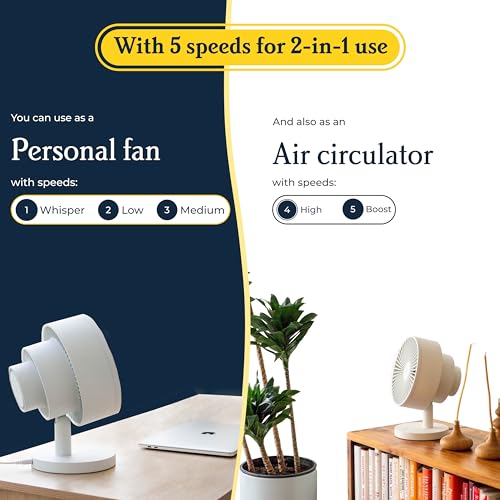
The Windmill is the circulator we recommend if you want a quiet, compact fan you can control any way you like. Whisper, Low and Medium act as a quiet desk fan, and High and Boost turn it into a circulator. It remembers your last setting.
It does not oscillate and costs more than most fans its size.

Windmill Smart 2-in-1 Air Circulator Fan




As an Amazon Associate we earn from qualifying purchases. Product prices and availability are accurate as of the date/time indicated.
Key Specifications
| Feature | Specification |
|---|---|
| Brand | Windmill |
| Type | 2-in-1 desk fan and air circulator |
| Noise Level | From 18 dB |
| Speeds | 5, Whisper to Boost |
| Smart Control | App and voice |
| Remote | Included |
| Memory | Remembers last setting |
| Size | 10.7 inches tall |
| Weight | 2.5 lbs |
| Oscillation | None, tilt head |
Noise and Speeds
At its Whisper setting, Windmill rates the fan from 18 dB, quiet enough for sleep or calls.
High and Boost move enough air to circulate a small room, summer or winter.
Smart Control
The app, voice commands, soft-touch buttons and included remote all control the fan.
At 2.5 lbs and 10.7 inches tall, it fits a nightstand or desk.
Placement Tips
For whole-room circulation, set the fan on the floor or a low table and aim it across the longest part of the room or slightly toward the ceiling. Aim it straight at yourself only when you want a direct breeze.
If you run an air conditioner, place the circulator where it can push the cooled air into the rest of the room. In winter, aim it at the ceiling to bring warm air back down.
Running Costs and Care
DC motors draw little power, especially on the lower speeds most people use at night, so running the fan for many hours a day adds only a small amount to an electric bill.
Dust the grille and blades every few weeks during the season. A clean circulator stays quieter and moves air more efficiently.
How It Compares
Against DREO’s 565S, the Windmill includes a remote and starts quieter, while the DREO oscillates on both axes.
Against the BLUEAIR CoolDrift, the Windmill adds smart control, while the BLUEAIR is quieter and oscillates.
Pros and Cons
| Pros | Cons |
|---|---|
| From 18 dB | No oscillation |
| App, voice and remote | Small reach |
| 5 speeds | Pricey for its size |
| Remembers settings | Needs Wi-Fi for app |
| Small and light | Plastic build |
Who Should Buy It
| Who Should Buy It? | Who Should Look Elsewhere? |
|---|---|
| Bedrooms | Large rooms |
| Home offices | Anyone who wants oscillation |
| Smart homes | Tight budgets |
| Light sleepers | People without Wi-Fi |
For more options, see our picks for the best quiet air circulator fans and the best air circulator fans for home office.
Final Verdict
The Windmill Smart Fan is a quiet, compact circulator with every control option. You can check the current price and details for the Windmill Smart 2-in-1 Air Circulator Fan.
Frequently Asked Questions
How quiet is the Windmill Smart Fan?
Windmill rates it from 18 dB.
Does it have a remote?
Yes, plus app and voice control.
Does it oscillate?
No. You tilt the head by hand.
How many speeds does it have?
Five, from Whisper to Boost.
Does it remember settings?
Yes. It returns to your last setting.
About the author
Daniel Brooks is a home cooling editor at WikiCooling, covering window, portable, through-the-wall and mini-split air conditioners, fans, and dehumidifiers. He researches cooling capacity, energy efficiency, noise levels, installation requirements, and buyer feedback to help homeowners choose the right unit for their room size, climate, and budget.