
Amazon Basics 50 Pint Dehumidifier with Pump Review: A Strict DOE Rating
Amazon Basics' 50 pint with pump is rated under the strict DOE test and is ENERGY STAR certified.
 By Daniel Brooks
Updated October 24, 2026
The Amazon Basics 50 Pint Dehumidifier with Pump is rated at 50 pints a day under the DOE test of 65 degrees F and 60% humidity, the strictest rating among the portable compressor dehumidifiers we cover.
Our Verdict
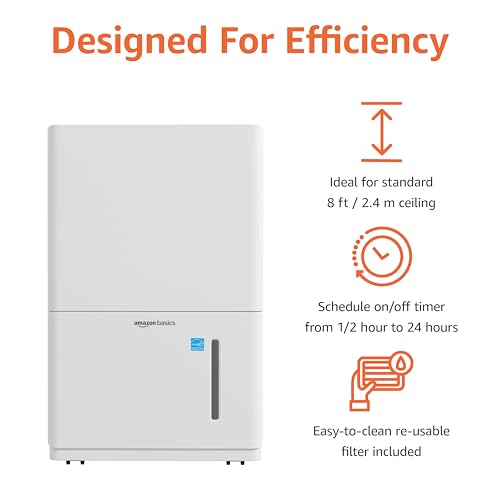
This Amazon Basics unit removes more water than its number suggests next to budget brands, because its 50 pints come from the cool DOE test. Amazon Basics also lists up to 102 pints at 90 degrees F and 90%. It has a built-in pump, auto defrost, overflow protection, a timer and auto restart, and it is ENERGY STAR certified.
It has no Wi-Fi and fairly basic controls.

Amazon Basics 50 Pint Dehumidifier with Pump



As an Amazon Associate we earn from qualifying purchases. Product prices and availability are accurate as of the date/time indicated.
Key Specifications
| Feature | Specification |
|---|---|
| Brand | Amazon Basics |
| Model | 50 Pint with Pump |
| Capacity | 50 pints per day at 65 degrees F, 60% RH |
| Maximum | 102 pints per day at 90 degrees F, 90% RH |
| Coverage | Up to 2,500 square feet |
| Drainage | Built-in pump |
| Features | Auto defrost, auto restart, timer |
| Certification | ENERGY STAR |
Capacity
The DOE rating at 65 degrees F and 60% RH is the most realistic for basements, so 50 pints here compares with much higher numbers on budget listings.
Amazon Basics lists coverage up to 2,500 square feet.
Features
The built-in drain pump supports continuous operation, and auto defrost keeps it working in cool spaces.
The reusable filter is simple to clean.
Placement Tips
Set the dehumidifier in the dampest part of the space, a few inches from walls and furniture so air can flow in and out. Close windows and doors while it runs so it is not drying the outdoors.
In a basement, a central spot works better than a corner, and a level floor keeps the bucket and pump working properly.
Running Costs and Care
Set the humidistat to around 45% to 50% so the compressor cycles off once the space is dry, which keeps power use down.
Rinse the filter every couple of weeks during heavy use, and check the bucket and hose for buildup. A clean unit removes more water.
How It Compares
Against GE’s 50 pint with pump, the Amazon Basics costs less, while the GE lists a 15 ft lift and Smart Dry.
Against Levoit’s Most Efficient model, the Amazon Basics rates higher on the DOE test, while the Levoit adds app control.
Pros and Cons
| Pros | Cons |
|---|---|
| Strict DOE rating | No Wi-Fi |
| Built-in pump | Basic controls |
| ENERGY STAR certified | Large and heavy |
| Auto defrost and restart | Pump lift not stated |
| Reusable filter | Coverage figure modest |
Who Should Buy It
| Who Should Buy It? | Who Should Look Elsewhere? |
|---|---|
| Basements without a drain | Smart home users |
| Buyers who compare ratings | Bedrooms |
| Large damp rooms | Anyone who wants detailed controls |
| Value seekers | Tight spaces |
For more options, see our picks for the best dehumidifiers with pump and the best dehumidifiers under 250 dollars.
To see how it ranks against similar models, read our best dehumidifiers for basements.
Final Verdict
The Amazon Basics 50 Pint Dehumidifier with Pump pairs a strict rating with a pump at a fair price. You can check the current price and details for the Amazon Basics 50 Pint Dehumidifier with Pump.
Frequently Asked Questions
What does the DOE rating mean?
Capacity measured at 65 degrees F and 60% humidity, the current standard.
Does it have a pump?
Yes, built in.
Is it Energy Star?
Yes.
Does it auto restart?
Yes, after power outages.
Does it have Wi-Fi?
No.
About the author
Daniel Brooks is a home cooling editor at WikiCooling, covering window, portable, through-the-wall and mini-split air conditioners, fans, and dehumidifiers. He researches cooling capacity, energy efficiency, noise levels, installation requirements, and buyer feedback to help homeowners choose the right unit for their room size, climate, and budget.