
6 Best Window Fans Under $50 of 2026
We compared six window fans under $50 on noise, controls and fit.
 By Daniel Brooks
Updated October 28, 2026
A little more budget buys thermostats, quieter motors and more fans. Our list of the best window fans under $50 compares six models on noise, controls, airflow and fit.
Every fan here was listed under the price cap when we compared them. Prices change often, so check the product cards for the current price.
All Products Compared
| Product | Best For | Type | Speeds | Airflow | Fit | Controls |
|---|---|---|---|---|---|---|
| Tornado 2-Speed Dual Window Fan | Overall | Twin 9 inch | 2 | Intake, exhaust, circulation (manual) | 22 to 33 inches | Manual |
| Genesis Twin Window Fan with Thermostat | Thermostat | Twin 9 inch | 3 | Intake or exhaust | Expands 6.5 inches per side | Thermostat, LED |
| Comfort Zone Triple Window Fan | Triple fan | Triple fan | 3 | Intake | 25 to 36.7 inches | Dial, thermostat |
| BLACK+DECKER BFW9M Dual Window Fan | Simple | Twin 9 inch | 2 | Intake or exhaust (flip) | 22.5 to 33 inches | Mechanical dial |
| Holmes Digital Window Fan | Air exchange | Twin blade | Digital | Intake, exhaust, exchange (electronic) | Up to 37 inches | Digital |
| Amazon Basics Digital Twin Window Fan | Digital controls | Twin 9 inch | 3 | Intake or exhaust | 25 to 32 inches | Digital |
| Award | Product | WikiCooling Score About WikiCooling ScoreThe WikiCooling Score is our own rating from 0 to 10, based on the criteria described on our How We Review page. It reflects research, not laboratory measurement, and is never influenced by manufacturers, retailers, or affiliate commissions. Learn more › | |
|---|---|---|---|
| Best Overall |
 Tornado 2-Speed Dual Window Fan |
Buy | |
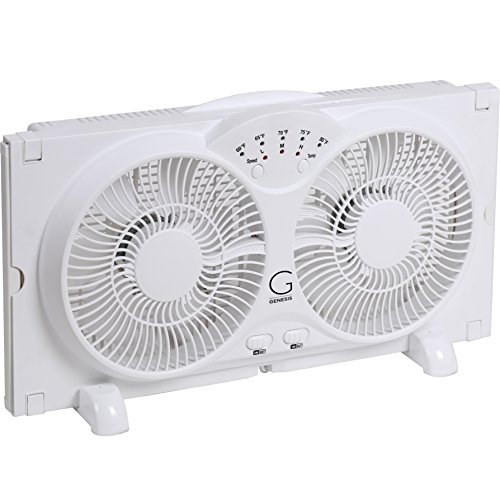 Genesis Twin Window Fan with Thermostat |
Buy | ||
| Best Premium |
 Comfort Zone Triple Window Fan |
Buy | |
| Best Budget |
 BLACK+DECKER BFW9M Dual Window Fan |
Buy | |
| Best Value |
 Holmes Digital Window Fan |
Buy | |
 Amazon Basics Digital Twin Window Fan |
Buy |


Top 3 Window Fans Under $50 Reviewed
#1 Tornado 2-Speed Dual Window Fan: Best Overall
Why We Picked It
Tornado’s manual twin fan is rated at a quiet 45dB, moves 1020 CFM and draws 60W, with manual intake, exhaust and circulation settings.
This is the simplest and quietest Tornado. Tornado rates it at 1020 CFM and 45dB, running at 1995 and 1627 RPM on its two speeds. Manual controls set intake, exhaust or circulation, so you can bring fresh air in, push stale air out or exchange the two. It draws 60W and expands to fit windows from 22 to 33 inches wide. There is no remote, but for a bedroom window you set once and leave, that is no hardship.
Key Specifications
- Fans: Twin 9 inch
- Airflow: 1020 CFM
- Noise: 45dB
- Speeds: 2
- Power: 60W
- Fit: 22 to 33 inch windows
| Pros | Cons |
|---|---|
|
|
Things to Consider
It fits windows up to 33 inches, so measure wider windows before buying. Manual intake, exhaust and circulation settings cover the same jobs as remote models, just from a dial on the fan. At 60W it costs very little to run all night.
Best For
This window fan is best for bedrooms and home offices.
Check the current price and availability of the Tornado 2-Speed Dual Window Fan on Amazon.
#2 Genesis Twin Window Fan with Thermostat: Best with Thermostat
Why We Picked It
Genesis’s twin fan has two 9 inch heads with their own copper motors, three speeds and a built-in thermostat from 60 to 80 degrees.
The Genesis adds a thermostat to the classic twin fan. Set it between 60 and 80 degrees and LED lights show the setting, with the fan running to hold your chosen temperature. Two 9 inch heads each have their own copper motor, three speeds cover low to high, and the airflow can run as intake or exhaust. Expandable side panels add 6.5 inches on each side, and it is ETL certified.
Key Specifications
- Fans: Twin 9 inch, dual copper motors
- Speeds: 3
- Thermostat: 60 to 80 degrees, LED indicators
- Airflow: Intake or exhaust
- Expanders: 6.5 inches per side
- Certification: ETL
| Pros | Cons |
|---|---|
|
|
Things to Consider
The thermostat saves you from switching it off when the room cools. At 8.4 pounds it is heavier than most twin fans, so make sure the window sash holds it securely.
Best For
This window fan is best for bedrooms.
Check the current price and availability of the Genesis Twin Window Fan with Thermostat on Amazon.
Read our full Genesis Twin Window Fan with Thermostat review.
#3 Comfort Zone Triple Window Fan: Best Triple Fan
Why We Picked It
Comfort Zone’s triple window fan lets you run one, two or all three fans, adds an adjustable thermostat and mounts horizontally or vertically.
Three fans instead of two give this Comfort Zone flexible airflow: run one for a gentle breeze or all three on a hot night. A manual dial selects the speed, and an adjustable thermostat dial helps hold a steady room temperature. Built-in expanders fit windows from 25 to 36.7 inches, and the slim body mounts horizontally or vertically, so it works in sliding windows too. It arrives fully assembled.
Key Specifications
- Fans: Three
- Speeds: 3
- Thermostat: Adjustable dial
- Fit: 25 to 36.7 inch windows
- Mounting: Horizontal or vertical
- Weight: 6 pounds
| Pros | Cons |
|---|---|
|
|
Things to Consider
The listing does not mention reversible airflow, so treat it as an intake fan. Running only one or two of the three fans gives a gentler, quieter breeze on mild nights, while all three move air fast on hot evenings. The thermostat dial helps it avoid overcooling the room.
Best For
This window fan is best for bedrooms and sliding windows.
Check the current price and availability of the Comfort Zone Triple Window Fan on Amazon.
Read our full Comfort Zone Triple Window Fan review.
Other Models Worth Considering
BLACK+DECKER BFW9M Dual Window Fan. BLACK+DECKER’s BFW9M is a simple twin fan you flip to switch between intake and exhaust.
Holmes Digital Window Fan. Holmes’ digital fan reverses each motor electronically.
Amazon Basics Digital Twin Window Fan. Amazon Basics’ digital twin fan adds electronic controls and three speeds.
What to Expect from Window Fans Under $50
A window fan sits in an open window and moves outdoor air in, indoor air out, or both. Pulling in cool evening air and pushing out the day’s heat can drop a room’s temperature noticeably without air conditioning, and running one fan in exhaust while another window stays open draws a breeze through the whole house.
For more options, see our guides to window fans under 40 and window fans under 75. For floor or window use in one room, our box fans page is another option. The product cards show the current price for each fan.
How to Choose Window Fans Under $50
Check the Noise
Twin 9 inch fans hum noticeably on high, so a bedroom fan should run quietly on low. Low-profile designs and DC motors are usually the quietest options.
Think About Controls
Manual dials are simple and reliable. Remotes, timers and thermostats let the fan run itself overnight, switching off when the room cools or after a set time, which saves getting out of bed.
Decide How You Will Reverse It
Some fans reverse electronically at the touch of a button, some have heads you rotate or push, and some you simply turn around in the window. If you plan to switch between intake and exhaust daily, electronic reversing or a remote is worth paying for.
Measure Your Window First
Measure the width of the opening for a double-hung window, or the height of the frame for a sliding window. Twin fans use expanders that cover a set range, low-profile fans use blocks, and vertical slider fans are sold in fixed height ranges. A fan that does not fit leaves gaps that let air and bugs in.
How We Evaluate Window Fans Under $50
We rank window fans on manufacturer specifications and listing details: fan type, speeds, airflow modes, window fit, controls, noise and build. We kept only new, in-stock window fans and left out renewed listings, resold third-party copies, box fans and solar vents. For this list we kept only new, in-stock fans listed under the price cap, then weighed noise, controls and fit.
Frequently Asked Questions
Can I leave a window fan on all night?
Yes. A timer or thermostat lets it switch off on its own once the room cools.
How much does a window fan cost to run?
Very little. Most twin fans draw well under 100 watts, a small fraction of an air conditioner.
Is a twin window fan better than a single fan?
Twin fans move more air and can run one fan in and one out. Single low-profile fans block less of the window and are often quieter.
Should a window fan blow in or out?
Blow in when outdoor air is cooler, and out to remove heat, smoke or odors. With two windows, one fan in and one out creates a cross breeze.
Final Verdict
The Tornado 2-Speed Dual Window Fan is the best window fan under $50, quiet at a rated 45dB. For a thermostat, choose the Genesis Twin Window Fan with Thermostat, and for flexible airflow, the Comfort Zone Triple Window Fan.
About the author
Daniel Brooks is a home cooling editor at WikiCooling, covering window, portable, through-the-wall and mini-split air conditioners, fans, and dehumidifiers. He researches cooling capacity, energy efficiency, noise levels, installation requirements, and buyer feedback to help homeowners choose the right unit for their room size, climate, and budget.