
Midea 7,800 BTU Inverter Window AC Review: 39 dBA, CEER 15.1
An ENERGY STAR 7,800 BTU inverter window air conditioner for rooms up to 340 sq. ft. with a listed 39 dBA, a CEER of 15.1, SmartHome app and voice control, a 24-hour timer and a quick-snap bracket.
 By Daniel Brooks
Updated October 8, 2026
The Midea 7,800 BTU Inverter Window AC (model MAW08V1KWT-A) is an ENERGY STAR certified unit for rooms up to 340 square feet. It uses a variable-speed inverter and lists a combined energy efficiency ratio of 15.1 and noise as low as 39 dBA. Among U-shaped window air conditioners, it is one of the quietest bedroom options, with 4.3 stars from 42 ratings.
It adds SmartHome app and voice assistant control, an LED display, a 24-hour timer and ECO mode. The main point to check is the tall minimum window height. We evaluated it based on the manufacturer’s specifications.
Our Verdict
This Midea is a top pick for a bedroom, nursery or home office. Its strongest points are the listed 39 dBA, the variable-speed inverter, a CEER of 15.1, ENERGY STAR certification, 4 modes, fan settings of auto, high, medium and low, a 24-hour timer, ECO mode, app and voice control, and a quick-snap bracket for installation.
The trade-offs are a minimum window height of about 19.5 inches, a bracket that must be fitted to the sill, a 52.6 pound weight and a 1 year limited warranty. It is not for casement windows. If your window fits, it is one of the quietest and most efficient ways to cool a room up to 340 square feet.

Prime Midea 7,800 BTU Inverter Window Air Conditioner



As an Amazon Associate we earn from qualifying purchases. Product prices and availability are accurate as of the date/time indicated.
Key Specifications
| Feature | Specification |
|---|---|
| Brand | Midea |
| Model | MAW08V1KWT-A |
| Type | Inverter window air conditioner |
| Cooling Capacity | 7,800 BTU |
| Room Size (listed) | Up to 340 sq. ft. |
| Efficiency | CEER 15.1, ENERGY STAR |
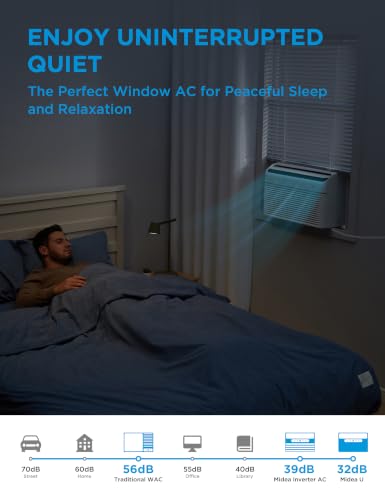
| Noise Level | As low as 39 dBA |
| Voltage / Power | 115V, 605W |
| Window Fit | 23″ to 36″ wide, 19.6″ minimum height (19.5″ on spec sheet) |
| Dimensions | 21.97″D x 19.17″W x 13.46″H |
| Weight | 52.6 pounds |
| Modes | Auto, Cool, Dry, Fan, plus ECO |
| Fan Settings | Auto, High, Medium, Low |
| Controls | LED display, remote, SmartHome app, voice assistants |
| Compressor | Variable-speed inverter |
| Warranty | 1 year limited |
Cooling Capacity and Room Size
Midea rates this unit at 7,800 BTU for rooms up to 340 square feet. It names bedrooms and apartment spaces as good fits.
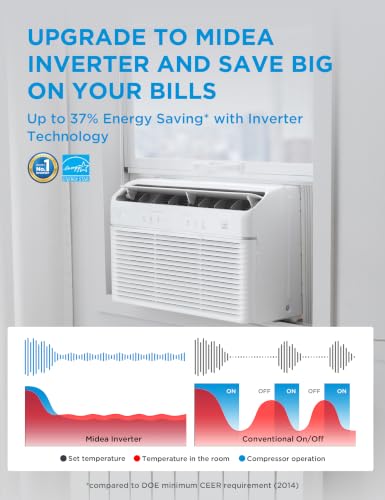
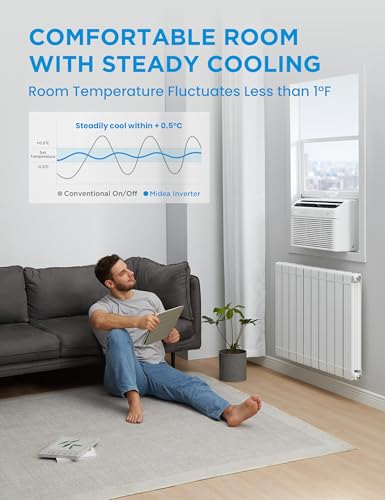
The variable-speed inverter is the key difference from a conventional unit. Rather than switching fully on and off, it adjusts its speed to hold the set temperature. Midea says this cools the room quickly while using considerably less electricity, with up to 37% energy savings compared with the Energy Conservation Standard.
The swing button moves the louvers up and down to direct airflow, and dry mode helps on humid days. Auto mode picks the right setting to hold your temperature.
ENERGY STAR publishes this general guide for sizing a room air conditioner by floor area:
| Room Size (sq ft) | Cooling Capacity (BTU/hr) |
|---|---|
| 100 to 150 | 5,000 |
| 150 to 250 | 6,000 |
| 250 to 300 | 7,000 |
| 300 to 350 | 8,000 |
| 350 to 400 | 9,000 |
| 400 to 450 | 10,000 |
| 450 to 550 | 12,000 |
| 550 to 700 | 14,000 |
| 700 to 1,000 | 18,000 |
Adjust for your room: reduce capacity by 10 percent for a heavily shaded room, increase it by 10 percent for a very sunny room, add 600 BTU for each regular occupant beyond two, and add 4,000 BTU if the unit cools a kitchen. Source: ENERGY STAR.
At its listed 7,800 BTU, it falls between the 7,000 and 8,000 BTU rows of the ENERGY STAR chart, which together cover rooms of about 250 to 350 square feet. That matches Midea’s 340 square foot claim.
Installation and Fit
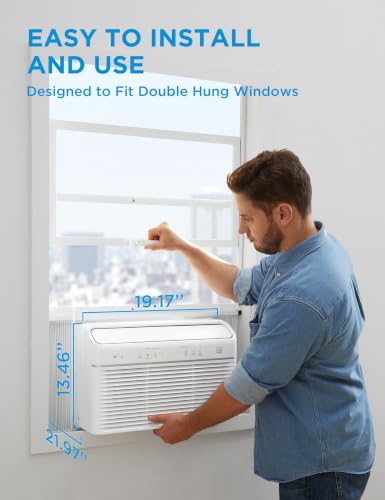
Installation follows three steps: fit the included quick-snap bracket, set the unit on the bracket and secure the sidearms. It fits single-hung or double-hung windows 23 to 36 inches wide. Midea gives a minimum height of 19.6 inches in the features, and the spec sheet gives 19.5 inches. It is not for casement windows.
The minimum height is the most important number to check, since it is taller than many window units need. Measure the open window carefully before ordering.
The unit measures 21.97 inches deep, 19.17 inches wide and 13.46 inches tall, and weighs 52.6 pounds. Plan for two people to lift it onto the bracket. It runs on a standard 115V outlet with a listed draw of 605 watts.
Noise, Energy Use and Efficiency
Midea lists noise as low as 39 dBA and says you will barely notice it, even on high. It is quiet enough for a video call or a conversation, and Midea says it also creates just the right amount of white noise for rest.
The listed CEER is 15.1, a strong figure for a window unit, and the unit is ENERGY STAR certified. The listed annual energy consumption is 676.7 kWh.
To get the most from the inverter, set a comfortable temperature and leave the unit running. It then works at low speed for long periods, which is where it is most efficient and quietest.
Controls and Smart Features
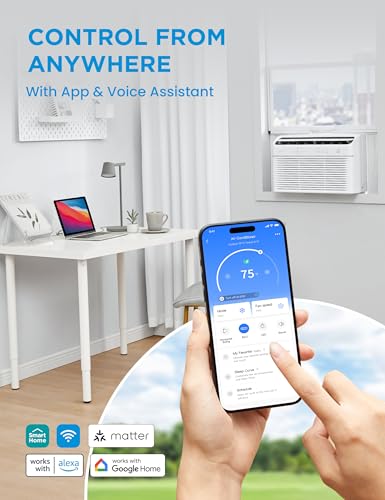
The LED display shows your settings, and the remote covers in-room use. You can also control the unit from anywhere with the SmartHome app and through voice assistant devices.
The 24-hour timer and ECO energy saver help cut running time. In a bedroom, a simple routine works well: cool the room before bed, let the inverter hold it quietly overnight and set the timer to switch off in the morning.
App control is most useful in a room that sits empty during the day. Start the unit from your phone on the way home rather than leaving it running while you are out.
Maintenance and Drainage
The listing does not describe the filter type or a cleaning schedule. Check the manual for how to remove and clean the filter, and clean it regularly during the cooling season. A clean filter keeps airflow steady and helps the inverter run efficiently.
The listing does not describe condensate drainage. Check the manual for how water is handled and how to remove the unit and bracket for winter storage.
Pros and Cons
| Pros | Cons |
|---|---|
| Listed as low as 39 dBA | Minimum window height of about 19.5″ |
| Variable-speed inverter with CEER 15.1 | Needs a bracket fitted to the sill |
| ENERGY STAR certified | Not for casement windows |
| SmartHome app and voice control | 1 year limited warranty |
| 24-hour timer and ECO mode | Filter details not listed |
Who Should Buy It
| Who Should Buy It? | Who Should Look Elsewhere? |
|---|---|
| Bedrooms up to 340 sq. ft. | Rooms larger than 340 sq. ft. |
| Light sleepers and nurseries | Windows under 19.5″ of opening height |
| Buyers who want inverter efficiency | Casement window owners |
| Smart home users | Renters who cannot fit a sill bracket |
| Home offices with video calls | Buyers who want a longer warranty |
Final Verdict
The Midea 7,800 BTU Inverter Window Air Conditioner combines a listed 39 dBA, a variable-speed inverter, a CEER of 15.1, ENERGY STAR certification, app and voice control and a 24-hour timer for rooms up to 340 square feet. The compromises are a tall minimum window height, a sill bracket and a 1 year limited warranty. You can check the current price and details for the Midea 7,800 BTU Inverter Window Air Conditioner, or compare other window air conditioners for bedrooms.
Frequently Asked Questions
What size room is the Midea 7,800 BTU inverter for?
Midea rates it for rooms up to 340 square feet. On the ENERGY STAR chart, its capacity sits between the rows for rooms of about 250 to 350 square feet.
How quiet is it?
Midea lists noise as low as 39 dBA.
What window does it fit?
It fits single-hung or double-hung windows 23 to 36 inches wide with a minimum height of about 19.5 inches. It is not for casement windows.
Can I control it with my phone?
Yes. It works with the SmartHome app and voice assistant devices.
About the author
Daniel Brooks is a home cooling editor at WikiCooling, covering window, portable, through-the-wall and mini-split air conditioners, fans, and dehumidifiers. He researches cooling capacity, energy efficiency, noise levels, installation requirements, and buyer feedback to help homeowners choose the right unit for their room size, climate, and budget.