
Pro Breeze 52 oz Mini Dehumidifier Review: A Bigger Tank for Small Rooms
Pro Breeze's larger Peltier mini removes up to 18 oz a day into a 52 oz tank for rooms up to 250 sq ft.
 By Daniel Brooks
Updated October 28, 2026
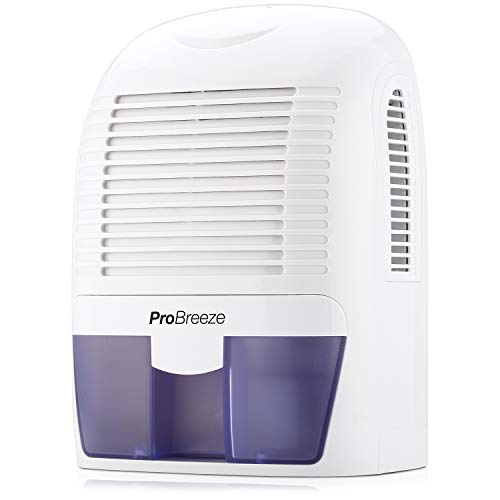
The Pro Breeze 52 oz Mini Dehumidifier is Pro Breeze’s larger thermoelectric dehumidifier. It removes up to 18 oz of water a day into a 52 oz tank and covers about 250 sq ft, quietly and without a compressor. For more models, see our Compact Thermoelectric Dehumidifiers page.
Our Verdict
This is our top pick among mini dehumidifiers for a damp bedroom, bathroom or office. The tank is big enough to run for days, the Peltier module is quiet, and it weighs only 4.5 pounds.
It has no humidistat, timer or drain hose, and like all Peltier units it slows down in cool rooms.

Pro Breeze 52 oz Mini Dehumidifier


As an Amazon Associate we earn from qualifying purchases. Product prices and availability are accurate as of the date/time indicated.
Key Specifications
| Feature | Specification |
|---|---|
| Brand | Pro Breeze |
| Model | 52 oz Mini |
| Moisture Removal | Up to 18 oz per day |
| Tank | 52 oz with auto shut-off |
| Coverage | Up to 250 sq ft |
| Technology | Thermoelectric (Peltier) |
| Weight | 4.5 pounds |
| Dimensions | 6.6 x 9 x 12.7 inches |
Design
The 52 oz tank is about three times the size of the 16 oz Pro Breeze, so it needs emptying far less often. When it is full, the unit switches off and an LED lights up.
At 6.6 x 9 x 12.7 inches and 4.5 pounds, it is easy to carry between rooms or take to a camper.
Controls
Controls are minimal: plug it in and switch it on. There are no modes, timers or humidity settings.
That simplicity suits closets and spare rooms, but you cannot tell it to stop at a set humidity.
Placement Tips
Set the dehumidifier on a level surface in the dampest part of the space, with a few inches of clearance around the intake and outlet. Close doors and windows while it runs so it is drying the room, not the outdoors.
Keep it in a room that stays above about 59 degrees F. Thermoelectric plates lose most of their effect in a cold garage or basement.
Running Costs and Care
Empty and rinse the tank every few days so it does not grow mold, and wipe dust from the intake grille. A clean unit removes more water.
Running costs are low: thermoelectric units draw roughly the power of a light bulb, so leaving one on around the clock costs little.
How It Compares
Against the 16 oz Pro Breeze, this model removes twice as much water a day and holds more than three times as much.
Against dual-core units such as the Litever Dual Core, the Pro Breeze removes less water but is a simpler, proven design.
Pros and Cons
| Pros | Cons |
|---|---|
| Large 52 oz tank | No humidistat |
| Quiet Peltier module | No timer |
| Light at 4.5 pounds | No drain hose |
| Auto shut-off | Slow in cool rooms |
| Covers about 250 sq ft | Pricier than budget minis |
Who Should Buy It
| Who Should Buy It? | Who Should Look Elsewhere? |
|---|---|
| Damp bedrooms | Basements |
| Small bathrooms | Cold garages |
| Home offices | Large rooms |
| Campers | Anyone wanting a humidistat |
For more options, see our picks for the best mini dehumidifiers and the best thermoelectric dehumidifiers.
Final Verdict
The Pro Breeze 52 oz Mini Dehumidifier is a quiet, low-maintenance mini dehumidifier for one damp room. You can check the current price and details for the Pro Breeze 52 oz Mini Dehumidifier.
Frequently Asked Questions
How much water does it remove?
Up to 18 oz a day in warm, humid conditions.
How big is the tank?
52 oz.
What area does it cover?
Up to 3,000 cubic feet, about 250 sq ft.
Does it shut off when full?
Yes, and an LED lights up.
Does it have a compressor?
No. It uses a thermoelectric Peltier module.
About the author
Daniel Brooks is a home cooling editor at WikiCooling, covering window, portable, through-the-wall and mini-split air conditioners, fans, and dehumidifiers. He researches cooling capacity, energy efficiency, noise levels, installation requirements, and buyer feedback to help homeowners choose the right unit for their room size, climate, and budget.